Every Parisian has a secret. A tiny restaurant that never appears in guidebooks. A quiet square that tourists walk past without noticing. A corner shop that sells the best croissants in the entire city. These are the places that make Paris feel like a city of infinite discovery — where even after a lifetime, you can still find something new.
This guide takes you beyond the Louvre, the Eiffel Tower, and the Champs-Élysées to explore five Paris neighbourhoods where the real magic happens. Each neighbourhood has been chosen for its character, its authenticity, and its concentration of hidden gems in Paris — the kind of places that Parisians guard closely and share only with their closest friends. For more details, check out our guide to Paris arrondissements guide.
1. Batignolles (17th Arrondissement) — The Village in the City
Batignolles is the neighbourhood that Parisians love most right now. Located in the north-west of the 17th arrondissement, it has a village-like atmosphere with tree-lined streets, a charming central square (the Place Batignolles), and a thriving food and shopping scene that rivals the Marais without the tourist crowds. The neighbourhood is centred on the Rue des Batignolles and the Rue de Lévis, a pedestrian market street with excellent bakeries, cheesemongers, and wine shops.
Hidden gems: Café Léopold on the Place Batignolles is the perfect spot for a morning coffee and people-watching. Le Mouchoir de Monsieur is a tiny, chef-run restaurant with a constantly changing menu that is one of the best values in Paris (€35 for a three-course lunch). The Square des Batignolles — a small park with a pond and a playground — is a lovely place to relax on a sunny afternoon.
2. Canal Saint-Martin (10th Arrondissement) — The Hipster Paradise
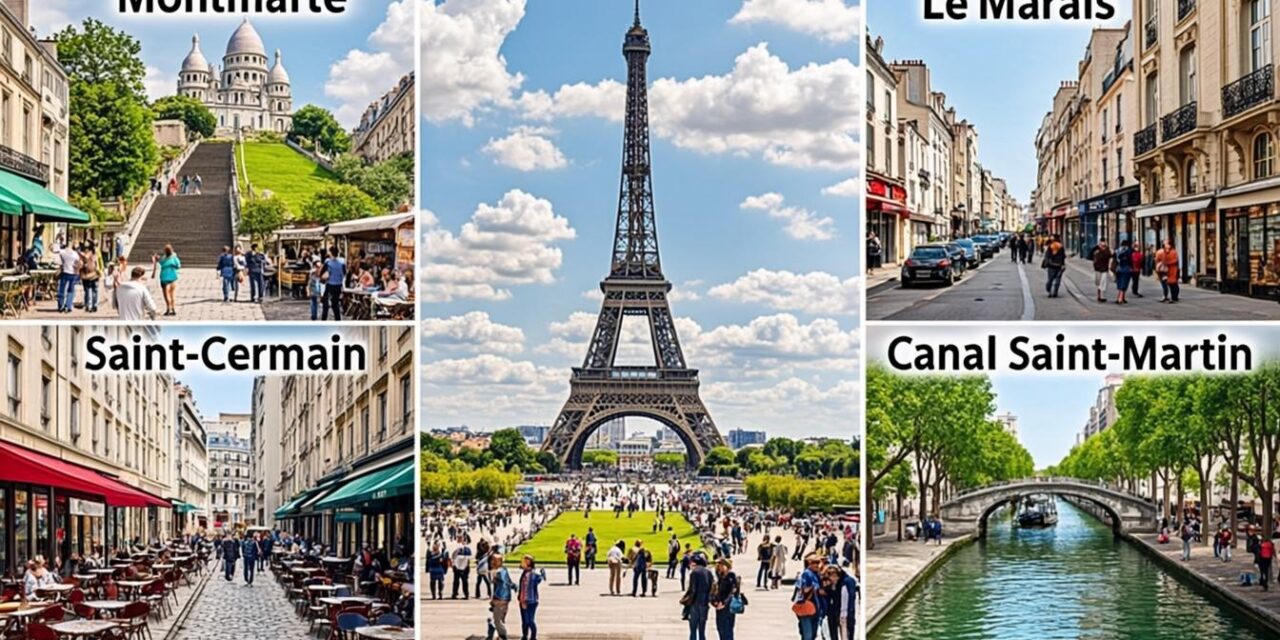
The Canal Saint-Martin has undergone one of the most dramatic transformations of any Paris neighbourhood in the past two decades. Once a gritty industrial waterway, the canal is now lined with some of the trendiest bars, restaurants, and cafés in the city. The area attracts a young, creative crowd, and the atmosphere is always buzzing. The canal itself is beautiful — with its iron footbridges, tree-lined towpaths, and houseboats — and walking its length is one of the most pleasant urban strolls in Paris.
Hidden gems: Le Comptoir Général is a bizarre and wonderful bar-restaurant-cum-museum dedicated to tropical culture, hidden behind an unassuming door on the canal bank. Holybelly serves the best brunch in Paris (arrive early — the queue is legendary). Café Smogasbard is an excellent specialty coffee shop with a bookshop attached. The Point Éphémère is a cultural centre housed in a former warehouse that hosts exhibitions, concerts, and performances.
3. Butte-aux-Cailles (13th Arrondissement) — The Artistic Hill
The Butte-aux-Cailles is a hilltop neighbourhood in the 13th arrondissement that feels like a small village frozen in time. Its narrow, winding streets are lined with low-rise buildings, small gardens, and some of the best street art in Paris. The neighbourhood has a strong artistic tradition — it was the site of the first powered flight by Clément Ader in 1890 — and today it is home to a thriving community of artists, musicians, and creatives.
Hidden gems: La Folie en Tête is a beloved neighbourhood bistro that serves excellent French comfort food at affordable prices. The Parc de la Butte-aux-Cailles offers one of the best viewpoints in Paris (yes, it rivals Montmartre guide). The street art along the Rue de la Butte-aux-Cailles and the Rue Bobillot is constantly changing and always impressive. Cave à Bulles is a tiny bar specialising in craft beers — an unusual find in wine-centric Paris.
4. La Chapelle (18th Arrondissement) — The Multicultural Mosaic
La Chapelle, located at the northern edge of the 18th arrondissement, is one of the most diverse neighbourhoods in Paris. It is home to large South Asian, North African, and Sub-Saharan African communities, and this diversity is reflected in the extraordinary food scene. The streets around the Rue de la Chapelle are packed with authentic Indian, Pakistani, Sri Lankan, and North African restaurants, shops, and markets. This is the neighbourhood to visit if you want to eat your way around the world without ever leaving Paris.
Hidden gems: The Rue du Faubourg-Saint-Denis (which runs through the adjacent 10th arrondissement) has some of the best Indian restaurants in Paris. Sri Lankan food on the Rue du Faubourg-Saint-Denis is outstanding and incredibly affordable. The Philharmonie de Paris concert hall, located at the edge of La Chapelle, is one of the finest music venues in the world.
5. Ménilmontant (20th Arrondissement) — The Bohemian Quarter
Ménilmontant is the neighbourhood where the real Paris lives. Located in the eastern 20th arrondissement, it is a working-class area with a strong artistic and bohemian tradition. The streets are hilly and winding, the bars are cheap and convivial, and the atmosphere is wonderfully unpretentious. Ménilmontant has been home to Edith Piaf, Maurice Chevalier, and generations of artists and musicians, and that creative spirit is still very much alive. For more details, check out our guide to Le Marais guide.
Hidden gems: The Rue Oberkampf and the Rue de Ménilmontant are lined with excellent bars and restaurants. Le Perchoir Ménilmontant is a rooftop bar with panoramic views of Paris — one of the best sunset spots in the city. The Cimetière du Père Lachaise is at the eastern edge of the neighbourhood and is one of the most beautiful and fascinating cemeteries in the world (the final resting place of Oscar Wilde, Jim Morrison, Edith Piaf, and Chopin). The Rue Sainte-Marthe has a cluster of excellent natural wine bars.
These five neighbourhoods are Paris at its most authentic — the city as it is actually lived, not as it is packaged for tourists. Explore them slowly, with an open mind and an empty stomach, and you will discover a Paris that most visitors never even know exists.