One of the first things you will notice when planning a trip to Paris is that nobody talks about neighbourhoods — they talk about arrondissements. But what exactly is an arrondissement? How many are there? How do you find your way around? And which ones should you visit, stay in, or skip? This comprehensive guide answers all those questions and more, giving you a complete understanding of Paris’s unique district system.
Paris is divided into 20 arrondissements (municipal districts), each with its own town hall, its own character, and its own loyal residents who will passionately defend their neighbourhood as the best in the city. Understanding how the arrondissements work is the key to unlocking Paris like a local — it is how Parisians navigate the city, how they describe where they live, and how they judge where to eat, drink, and socialise.
What Is an Arrondissement?
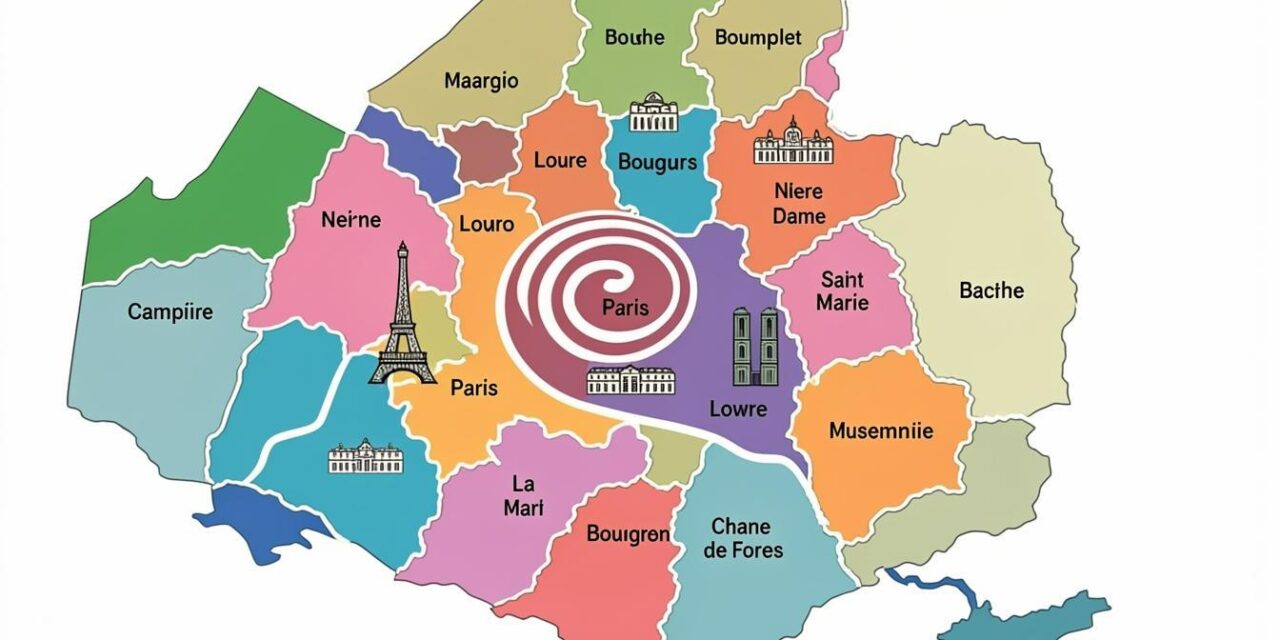
An arrondissement (pronounced “ah-ree-zohn-diss-mahn”) is an administrative division of Paris. Think of it as a borough or a district. Each arrondissement has its own mairie (town hall), its own mayor, and a degree of political autonomy within the wider city government. The arrondissements are numbered from 1 to 20, and the numbering system follows a distinctive spiral pattern that starts at the centre of the city and winds outward clockwise — like a snail shell.
This spiral arrangement is unique to Paris and can be confusing at first. The 1st arrondissement is at the very centre (home to the Louvre), and each subsequent number spirals outward. The 20th arrondissement, in the far east of the city, is the last stop on the spiral. The practical implication is that adjacent arrondissements do not always have consecutive numbers — the 1st is next to the 2nd, 3rd, and 4th, but the 8th (which is north-west of the centre) is not next to the 7th in the way you might expect.
Why does this matter? Because arrondissement numbers are embedded in Parisian daily life. When a Parisian says “I live in the 11th,” they are telling you not just where they live but something about their lifestyle — the 11th is trendy, vibrant, and food-obsessed. When a hotel is described as being “in the 6th,” you immediately know it is on the Left Bank, near Saint-Germain, and likely to be elegant and expensive. Learning to think in arrondissements is the single most important thing you can do to feel like you understand Paris. For more details, check out our guide to best arrondissements to stay in Paris.
The Complete Paris Arrondissements Map
To visualise the spiral, imagine starting at the Louvre and drawing a clockwise spiral outward. The first four arrondissements form a roughly square block in the centre. Arrondissements 5–7 make up the Left Bank (south of the Seine). Arrondissements 8–12 form the right-hand side of the spiral, including the Champs-Élysées, the Bastille, and the Marais. Arrondissements 13–20 form the outer ring, encompassing more residential and less touristy areas.
The easiest way to remember the layout is: the lower the number, the more central the arrondissement. Arrondissements 1–8 are the tourist heart of Paris. Arrondissements 9–12 are the busy, vibrant “second ring.” Arrondissements 13–20 are the outer, more residential districts where real Parisians actually live.
Arrondissements 1–7: Central Paris
1st (Louvre): The geographic centre of Paris, home to the Louvre Museum, the Tuileries Garden, the Palais Royal, and the western tip of the Île de la Cité. Expensive, touristy, but undeniably convenient. Best for: sightseeing convenience and best arrondissement for first-time visitorss who want to walk everywhere.
2nd (Bourse): A small, often overlooked arrondissement centred on the old Paris stock exchange (La Bourse) and the beautiful Passage des Panoramas, one of the city’s historic covered arcades. It is a quiet, business-oriented district by day and has some excellent restaurants. Best for: food lovers exploring the covered passages and office workers on lunch break.
3rd (Upper Marais): The northern part of the Marais, this is one of the trendiest neighbourhoods in Paris. It is home to the Musée Picasso, the Musée Carnavalet (Paris history museum), and some of the city’s best independent boutiques and galleries. Best for: design lovers, vintage shoppers, and those who want a trendy but quiet base.
4th (Lower Marais and Île Saint-Louis): The southern, busier part of the Marais, plus the Île Saint-Louis and the northern part of the Île de la Cité (Notre-Dame). This is the most vibrant and diverse central arrondissement. Best for: first-time visitors, foodies, nightlife lovers, and anyone who wants a lively, walkable base.
5th (Latin Quarter guide): The historic intellectual heart of Paris, home to the Sorbonne, the Panthéon, the Jardin des Plantes, and the Shakespeare and Company bookshop. Slightly more affordable than the 4th or 6th, with a wonderful student-town energy. Best for: history buffs, budget-conscious travellers, and anyone who loves bookshops and cafés.
6th (Saint-Germain-des-Prés): The quintessential Left Bank neighbourhood — elegant, literary, and expensive. Home to the Jardin du Luxembourg, Café de Flore, Les Deux Magots, and some of the finest restaurants in Paris. Best for: couples, luxury travellers, and anyone who wants classic Parisian elegance.
7th (Eiffel Tower): The safest and most upscale residential arrondissement in Paris, home to the Eiffel Tower, the Musée d’Orsay, and numerous embassies and government buildings. Quiet, clean, and very expensive. Best for: families, romance-seekers, and those who prioritise safety and iconic views.
Arrondissements 8–14: The Surrounding Ring
8th (Champs-Élysées): Home to the Arc de Triomphe, the Champs-Élysées, and the Madeleine church. This is the most commercially glamorous arrondissement, with luxury boutiques, grand hotels, and Michelin-starred restaurants. Best for: shoppers, business travellers, and those who want a glamorous base near the Champs-Élysées.
9th (Opéra): Centred on the magnificent Palais Garnier opera house, the 9th also includes the Grands Boulevards shopping area and the vibrant Pigalle district (home to the Moulin Rouge). A diverse neighbourhood with something for everyone. Best for: theatre lovers, nightlife seekers, and budget shoppers.
10th (Canal Saint-Martin): Once gritty and overlooked, the 10th has undergone a dramatic transformation and is now one of the trendiest neighbourhoods in Paris. The Canal Saint-Martin is lined with fashionable cafés, bars, and restaurants. Best for: hip travellers, foodies, and those who want an authentic, non-touristy experience.
11th (Bastille and Oberkampf): The current epicentre of Parisian cool. The 11th has the city’s best concentration of natural wine bars, craft cocktail spots, and creative restaurants. The Oberkampf area has fantastic nightlife. Best for: foodies, nightlife lovers, and travellers who want to experience contemporary Parisian culture.
12th (Bastille and Nation): Home to the Bois de Vincennes (Paris’s largest park), the Coulee Verte (elevated garden walkway, similar to the High Line in New York), and the vibrant Bastille area. Best for: park lovers, families, and those who want green space and outdoor activities.
13th (Butte-aux-Cailles and Chinatown): A diverse, affordable neighbourhood with a thriving Asian food scene in the Triangle de Choisy (Paris’s main Chinatown) and a charming village-like area around Butte-aux-Cailles. Best for: food adventurers on a budget and those who want to explore beyond the tourist trail.
14th (Montparnasse): Once the centre of Parisian artistic life (Picasso, Modigliani, and Hemingway all lived here), Montparnasse is now a quiet, residential neighbourhood with excellent restaurants, the beautiful Catacombs of Paris, and the Parc Montsouris. Best for: history lovers, cemetery tourists (the Montparnasse Cemetery is beautiful), and those who want a quiet base with good transport links.
Arrondissements 15–20: Outer Paris
15th: The largest and most populous arrondissement, the 15th is a pleasant, residential neighbourhood with excellent markets (the Rue Cler-style Rue du Commerce), the Parc André Citroën, and very reasonable hotel prices. Best for: families and budget-conscious travellers who do not mind a short metro ride to the centre.
16th: The most affluent residential arrondissement, home to the Trocadéro, the Bois de Boulogne, and some of the most expensive real estate in Paris. Very quiet and very safe, but limited restaurant and nightlife options. Best for: wealthy travellers who want a peaceful, luxurious base.
17th: A diverse arrondissement that ranges from the chic Parc Monceau area in the south to the more bustling Batignolles district in the north. Batignolles has become one of the most desirable neighbourhoods for young Parisian families. Best for: those who want a local, village-like experience away from the tourist crowds.
18th (Montmartre guide): Home to the Sacré-Cœur Basilica, the Moulin Rouge, and the artistic village of Montmartre. The area around the basilica is touristy but magical, while the northern part of the arrondissement (around Barbès) is grittier. Best for: romantics, art lovers, and those who want the most iconic views in Paris.
19th: Home to the Parc des Buttes-Chaumont (one of the most beautiful parks in Paris), the Canal de l’Ourcq, and the Cité des Sciences science museum. An up-and-coming neighbourhood with a young, creative population. Best for: park lovers, families, and those who want to see a different side of Paris.
20th (Belleville and Ménilmontant): One of the most diverse and creatively vibrant neighbourhoods in Paris. Belleville has a wonderful street art scene, excellent ethnic restaurants, and stunning views from the Parc de Belleville. Ménilmontant has great bars and a bohemian atmosphere. Best for: creative travellers, street art lovers, and those who want to experience multicultural Paris.
The Best Arrondissement for Every Type of Traveller
Best for food: The 11th — unparalleled concentration of excellent restaurants and bars. Best for romance: The 6th or 18th — Saint-Germain’s elegance or Montmartre’s views. Best for families: The 7th or 15th — safe, spacious, and close to parks. Best for budget: The 5th, 13th, or 15th — more affordable than central arrondissements with excellent transport links. Best for nightlife: The 11th or 10th — the epicentre of Paris’s bar and club scene. Best for shopping: The 4th (Marais boutiques) or 8th (Champs-Élysées luxury). Best for first-timers: The 4th — central, vibrant, walkable, and endlessly interesting.
Related reading: neighborhoods to live